Devising: Evaluation
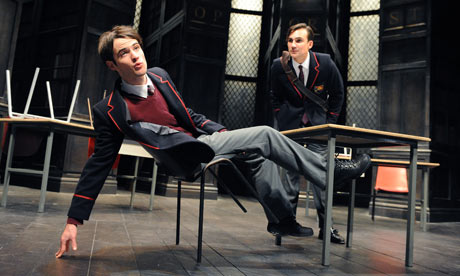
Last week, we performed our pieces to year 10 and 11 in front of the camera. I have to admit that I was pretty nervous about performing it to an audience as last years devising went tremendously well and we felt more ready to perform it, plus, we were more confident in our piece. I think the main reason for this was that we picked a much more sophisticated and mature topic to create a piece around. This topic was education and how the disciplinary sanctions and behaviour of schools have changed over the course of the last 100 years, and the possible futures of schools in the next generation or two. We took a great deal of inspiration from the play “Future Conditional,” which we saw as a class at the Old Vic in London this year. We loved the humorous side of the show and wanted to replicate a piece like that, exploring deep issues within education and how we could combat these issues. We wanted to create a piece which showed off our maturity and sophistication. For example, we spent a lot of time writing various scripts for our meeting scenes.
This entailed a lot of research, picking out different quotes and real life statistics which we could use in our piece to create the illusion that the piece was real rather than fictitious.
Creating quality dialogue was the main problem, none of us had ever really written a script before, let alone the four we eventually used in our piece. I had written one back in year 10 but most of us were used to improvising scenes and gradually tweaking them and committing them to memory. As the only A level English student in the group I took lead on the script front, while others contributed with ideas. The part I found most difficult was nit the actual content of the script, I had an abundance of quotes and stats to my disposal, and the direction the piece was moving in, but trying to match the lines with the right character was hard. We all developed and discussed the different characters each of us would play, based around the stereotypical characters in a meeting scene. Forexample, we had one person arrive late, the one who takes it very seriously, the more outgoing one and so on, so fitting the lines to match was difficult, particularly as we wanted to make our scenes serious, yet comical giving a real insight into a school teacher meeting. I've forgotten the amount of time we spent writing scripts and performing them to our teacher so we could annotate and re draft the script.., however, I feel that these workshop sessions with our script allowed us to make changes to allow the dialogue to flow more, emphasise our different characters and create a more accurate meeting atmosphere. In hindsight, I think we spent a little too long on the scripts and redrafting them when we could have been running through the scenes, giving us a better understanding of our lines so we didn’t panic about learning them a week before the show. Having said that, I think we pulled it off very well though, we got laughs where we expected them and managed to improvise to add some comedy which worked very well for our particular audience. I believe I’m correct in saying that one of the year 10’s admitted they would have paid to have watched us of we were professional, just wanted it to be longer, which, perhaps, we could have made longer if we weren’t conscious of the time restraints of 5 minutes per person. Either way, this was an incredibly encouraging comment and filled us with pride and reassured us that what we had created was both en capturing and comical at times, whilst providing a storyline that the audience could follow and understand easily.
I think a strong point in our piece was the quality of our scenes, from the sound scape, to the dialogue and movement. I think they all showed off different skills and our adaptability as a group as well as the maturity and sophistication we endeavoured so hard to show. Our movement pieces were more planned than before, introducing chairography was a completely new thing for me, but I think it worked nicely and wasn’t too difficult to pull off. The planning of the movement pieces made it much easier to devise a piece and stick to it. We spent a lot of time trying to think of effective and stylistic movements we could use in our performance. This wasn’t always easy. For one particular movement scene, we created one piece, felt as if it was extremely dull and boring and went onto create a new one. Although our feedback suggested that our previous one was better, hence we tried to merge the two pieces into one for our finished product. We achieved this, but stupidly, didn’t record it, so when we revisited the scene a few weeks later, we had forgotten, therefore had to spend time trying to remember the steps. This was a waste of time and had we have recorded it, would have allowed us to focus on other areas.
Another positive in our decision making process was the fact that we all decided on costumes withinaround ten minutes. We all agreed to wear business style clothing to replicate a teacher look and to just scruff it up when playing students. This was very practical as our traverse stage had no where to get changed and it would have taken too long anyway. So our costume changes were smooth and quick, allowing us to worry about the performance and not whether or not we would have time to get the right clothing on. We did miss one piece of costume however, which was the robe we wanted someone to wear for the Victorian teacher scene. This was only a minor issue though as the piece ran as smoothly without it, and if I’m honest wouldn’t have really made any difference good or bad.
One of the main issues we faced as a group was one of our group members needing to take two weeks off for an operation. We always knew this so we tried to get all our movement pieces set before he left, which we achieved, but needed to finish all our scripts in time, which we got to him one week before the performance, which probably, wasn’t enough time as we only had two lessons with him when he came back before the actual performance. The scripts should have been completed much quicker, however, I suppose we spent so much time on them as they were a feature point of our performance and we wanted the dialogue to be meaningful and have quality. I think the main negative in the absence of our member was the lack of rehearsal time we had leading up to the performance. In the last week, we had pretty much everything finished, bar the lighting and sound, yet we couldn’t rehearse properly without him. We saw this opportunity to get the more technological aspects sorted. We recorded the sounds we wanted for our sound scape and put them onto “Audacity” which allowed us to layer all our recordings of typical classroom sounds together, whilst adding in other sounds such as a drum beat or ringing. Whilst our member was off he devised a lighting plan for himself so he could come in and crack on with it straight away. I made a decision to make a last minute lighting change for the scene where my character gets caned. Originally, we had a series of quick blackouts to accompany a whip sound, and every time the lights came back up the whole cast had moved into the same position as if they had been struck, we didn’t have time to have ever set this, or have enough time with he lighting to get our timings right. Therefore, we thought a blackout with the cane sound would be easy, avoid any confusion and work well. Ideally, we would have loved to have had time to add in cool lighting effects and strobes, but we did not have enough time to practice it. Nevertheless, I was still proud of how we encountered such problems and dealt with them, and how we used our time as effectively as we could.
Last time we undertook a devising unit, we didn’t really think of staging it any differently from what we had been used to, which was the traditional proscenium arch layout. However, this time, both groups decided to change this. After watching a performance of the Black Watch by BBC Scotland, we decided that we wanted to stage our own piece in the traverse style, not only because it was a style that interested us, but because it was different from what we had done before and presented anew challenge for us in terms of how we staged our scenes, which turned out to be more difficult than we previously imagined. Time and time again we had to change the way we staged certain scenes to make sure that the majority of the audience could see what was happening. Of course, no matter where you are on the stage there will always be a section of the audience that your back is turned upon, so we had to think carefully about how we were standing or how we positioned our chairs in our meeting scenes as we sat down during most of the performance. One particular problem we encountered was our first movement scene, where we had an arch of chairs positioned in the middle of the stage. This meant that the audience behind us would not be able to see any of our faces or actions and would be cut out of the performance essentially, hence, we had to set the chairs at one end of the stage so all could where we were, and be a art of the scene as a result. In fact, we had to tweak the positioning of most scenes to ensure that the whole audience had clear view of at least one of us from different angles. This was a completely different challenge to what we had experienced before, to be honest, I don’t think we even thought about how difficult the staging was. Nevertheless, it soon occurred to us that we needed to give careful consideration to the staging, and I think we came up with good solutions that reflected our conscious effort to stage effectively.
In conclusion, I feel that we done a very good job of creating a sophisticated and mature piece. I feltas if we researched well to come up with a range ideas and slowly build upon our research to create the most interesting and complex scenes we have ever attempted to put together. We worked very efficiently as a team, never arguing, but discussing maturely to express our ideas and feelings. Although we encountered problems, we dealt with them as best we could and the end product, was actually something to be proud of. I think one area that could have been dealt more professionally was the speed at which we formed our performance. I think we spent way too long trying to write our scripts and this limited our rehearsal time, so in future, I think this area will need to be improved, whether that be spending ore time out of lesson or improvising more.